
Recent Bootcamps
Explore the exciting and interactive workshops we host! Our aim is to introduce you to various domains of computer science through end to end real world project development! Our philosophy is tech for social impact. Our project explored themes of sustainability, ethics and aim to help vulnerable stakeholders in society


Computer Vision for Visual Impairment
Using opencv and easyocr libraries we built text and object detection algorithms that work on static images, videos and live on webcam. This has huge potential for people with visual impairments and the challenges they face in their daily life. Our bonus distance measurement project helps identify the distance between incoming objects! We can combine with with IoT or apps to build functional products!
Mental Health Retrieval Augmented Generation Chatbot
Using Langchain we built an end to end pipeline including data extraction, vectorization, embeddings, vector databases and generation pipelines to build a chatbot answering mental health queries based on a custom dataset of information. This is huge in an age of decentralized information and can be used in medicine, finance and other fields as well!


Noble Prize Data Science Analysis Project
During this workshop we used used pandas, matplotlib, plotly, seaborn to create data visualizations such as box plots, regression plots, choropleth maps, sunburst charts, bar graphs, pie charts and more. We analyzed issues like gender disparity in laureates, factors affecting winning country distribution, why certain research institutes are more successful, age of laureates and trends in number of awards. These are key guidelines that pave the path to understand the role of socio-economic factors in the Nobel Prize
Accesible Web Design
In this workshop we focused on the fundamentals of HTML & CSS starting from scratch. Students also learned about Google's developer tools and how to use them. Additionally, we introduced participants to Bootstrap and how they can incorporate it into their websites. The final project was a interactive portfolio website combining everything. We ended with a discussion on how accessibility in web design for people with various disabilities is crucial and emerging in modern websites.

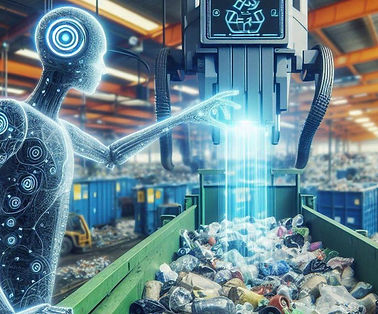
Machine Learning for Waste Segregation & Classification
Students build an entire machine learning pipeline from scratch! This included dataset cleaning, visualization, building their 1st ML model and testing it on real time data! The algorithm was successfully able to sort waste in plastic, paper, cardboard, metal, trash and other categories. In a broader sense, they could build an IoT waste recycling AI for renewable and non renewable waste to test in recycling centers and their local community. Using the power of machine learning students can extend this to infinite purposes!
APIs IN REAL WORD SCENARIOS
We explored several APIs on finance, news headlines, chatbots and carbon utilization. First, we built a code analyzing company stock data and then using an API to get the top news headlines ( a huge issue is access to information today ). Then we experiment with Groq chatbots as accessible free GenAI tools. Finally we used the Climatiq & Carbon Interface API to calculate carbon used for electricity usage, vehicular trips and more!


Databases & BigData
This was a special workshop catered for hackathon participants to advance their projects to the next level. Students used firebase, SQL, NoSQL, Cypher to learn about relational and non relational databases. They built a final project based on idea sharing and collaboration wherein people globally could contribute solutions and ideas on humanitarian crises onto a database which would then be displayed on a website. They also learned about their real world potential in locating nearest hospitals, food centers, shelters in times of need.
NLP Disaster Tweet Prediction
This was a personalized workshop where we used a dataset of fake and real twitter disaster tweets and built a NLP machine learning pipeline to classify them in real time. This is very useful to prevent misinformation, false alerts and spotlight actual crisis posts on twitter for emergency services. Similar pipelines can be applied to spam detection. Students learn vectorization, embeddings, Naive Bayes, GRU, LSTM, CONV1D and other such models
